Discover how long does lip filler take to wear off
If you are thinking about having lip filler, or you have already undergone treatment, one question tends to come up sooner or later: how long does lip filler take to wear off? There is no single answer that applies to everyone because lip filler does not have a fixed expiry date.
Most modern lip augmentation treatments use temporary, absorbable fillers. With hyaluronic acid fillers, the body gradually breaks down and absorbs the material over time. This means the result generally becomes less noticeable progressively rather than disappearing from one day to the next.
How long the effect remains visible can depend on several factors, including the characteristics of the filler, the amount used, the injection technique, your natural lip anatomy, previous treatments and your individual biological response. The lips are also constantly moving when we speak, smile, eat and express ourselves, making them a particularly dynamic area of the face.
At Kings Medical Center in Dubai, lip filler treatment starts with an individual assessment. Rather than deciding how much filler should be used according to a trend or a standard formula, the aim is to understand the patient’s natural proportions, expectations and treatment history before determining whether filler is appropriate.
In this guide, we will explain how long lip filler may last, why results differ between patients, what happens as filler gradually wears off, whether it can disappear completely, why lips can look smaller shortly after treatment and when another assessment may be useful.
How long does lip filler usually last?
Hyaluronic acid lip filler is designed to provide a temporary result. In many patients, visible improvement can remain for several months, and results may still be noticeable around 6 to 12 months after treatment. However, this should always be understood as an approximate timeframe rather than a promise that every person’s filler will last for exactly the same period.
Research illustrates how variable these results can be. A systematic review and meta-analysis assessing hyaluronic acid lip augmentation found that approximately 74% of patients still showed an improvement in lip fullness six months after treatment, while around 46% remained responders at 12 months.
This does not mean that exactly half of the filler remains after a particular number of months. Clinical studies assess visible or measurable improvement according to specific scales, while patients tend to judge their treatment based on how their lips look and feel. These are not necessarily the same thing.
It can therefore be more useful to think about lip filler as following a gradual life cycle.
Immediately after treatment, the lips may look fuller than expected because the injected filler is combined with temporary swelling. During the following days, this initial swelling begins to settle. Once the tissues have recovered, the more stable result becomes easier to appreciate.
Over the following months, the lips may slowly begin to lose some volume, projection or definition. The change is usually subtle at first. You may notice that the border of the lips appears slightly less defined or that the central part of the lips is less prominent than before.
Eventually, the effect may become minimal enough that you feel your lips have returned close to their previous appearance.
There is therefore no precise moment at which a clinician can say that filler has officially “expired”. One patient may feel that the effect has reduced considerably after several months, while another may still see a noticeable difference after a year.
The best way to decide whether further treatment is appropriate is not simply to count the months since your previous appointment. It is to evaluate the current condition of the lips and determine whether additional filler is actually necessary.
What makes lip filler wear off faster or slower?
Patients often compare their experience with friends or with results they see online. Someone may say that their lip filler lasted more than a year, while another person feels that their result changed much sooner. Both experiences may be possible because several variables contribute to filler longevity.
One important factor is the type and physical characteristics of the filler material. Hyaluronic acid fillers are not all identical. Their formulation and the way the hyaluronic acid is structured can influence how the material behaves within the tissues and how long its effect persists. Hyaluronic acid itself is a substance naturally present in body tissues, and filler formulations are designed to provide volume before gradually being absorbed.
The amount used can also influence the visible result, although using more filler should never be considered a simple method for making a treatment “last longer”. The correct quantity needs to be chosen according to the anatomy and desired outcome. Adding unnecessary volume can change the balance and proportions of the lips.
Placement is another important consideration. Lip filler can be used to address different objectives, including:
- adding volume;
- improving lip definition;
- supporting particular areas of the lip;
- improving symmetry;
- refining the relationship between the upper and lower lip.
Two patients may therefore receive lip filler for completely different reasons, even if the procedure appears similar from the outside.
Your individual biology also plays a role. Temporary fillers are broken down naturally by the body, and this process does not occur at exactly the same rate in every person.
Previous treatment history is important as well. A patient having lip filler for the first time is not necessarily in the same situation as someone who has received multiple treatments over several years. Before additional filler is considered, existing volume, tissue condition and previous results should be assessed.
This is why it is difficult to answer how long does lip filler take to wear off without considering the individual patient. The expected duration can be discussed during an appointment, but an exact date cannot be guaranteed.
How does lip filler look as it starts to wear off?
One of the most reassuring things for patients to understand is that temporary lip filler does not usually disappear suddenly. The change generally happens progressively.
At first, you might notice very little difference. Over time, the lips may gradually appear less full than they did after the treatment had settled.
Depending on the objective of the original treatment, you may notice changes in different areas. For example, the lips may lose some projection when viewed from the side, or the border between the lips and surrounding skin may become less defined.
If the original goal was primarily to correct a small asymmetry, that difference may slowly become more visible again as the filler effect reduces.
Eventually, the lips tend to move progressively closer towards their baseline appearance.
It is important, however, to distinguish this process from what happens during the first few days after treatment.
Swelling is one of the most frequently reported reactions following hyaluronic acid lip injections, together with tenderness, bruising and temporary firmness.
Immediately after the procedure, swelling can temporarily increase the apparent volume of the lips. When the swelling reduces, some patients believe that their filler has already disappeared.
In many cases, what they are actually seeing is simply the difference between the immediate post-treatment appearance and the settled result.
This is why judging the final outcome too early can be misleading. The lips need time to recover from the injections and for temporary reactions to settle.
Patients should also avoid trying to manipulate, squeeze or aggressively massage the lips unless they have been specifically instructed to do so by the healthcare professional who performed the procedure. Advice found on social media should never replace personalised aftercare instructions.
If the appearance of the lips concerns you during recovery, contacting the clinic is preferable to experimenting with home techniques.
Why does lip filler sometimes seem to disappear quickly?
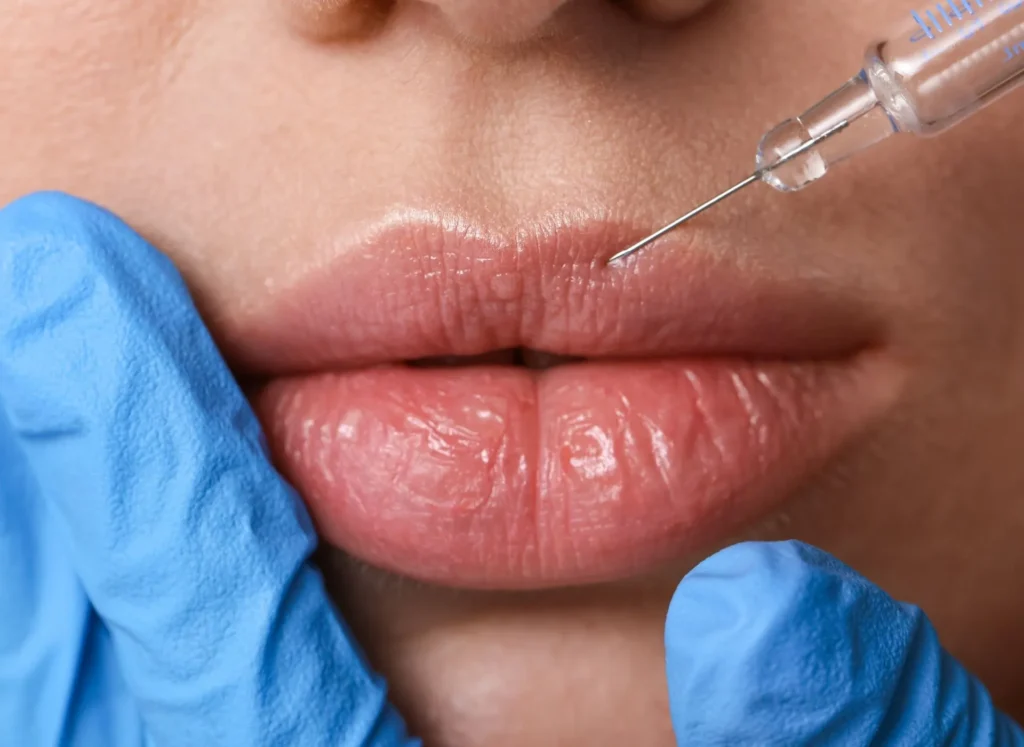
A patient may leave the clinic with noticeably fuller lips and then feel that much of the effect has disappeared within a week. Understandably, this can lead to the assumption that the filler has been broken down unusually quickly.
However, one of the most common explanations is reduced swelling.
The injections themselves temporarily affect the tissues. Swelling, bruising, redness, tenderness and discomfort are among the recognised reactions associated with dermal filler injections, and many of these reactions improve during the days following treatment.
Imagine that immediately after treatment your lips appear considerably fuller. Part of that appearance may be created by the filler, but part may also be temporary swelling.
As the swelling settles, the lips become smaller. This does not necessarily mean that the injected material has disappeared.
It is therefore important not to rush into additional treatment just because the lips look different from how they appeared immediately after the appointment.
Another reason the result may feel less noticeable is simply adaptation. When you see your face every day, you quickly become accustomed to subtle aesthetic changes. What initially seemed like a noticeable increase in volume can begin to feel normal after several weeks.
Looking at well-standardised before-and-after photographs may sometimes help patients evaluate the change more objectively than looking in the mirror from memory.
However, there are circumstances in which a change should not simply be assumed to be part of normal healing. Severe or increasing pain, unusual skin colour changes, significant swelling or other worrying symptoms should be assessed promptly.
Although serious complications of dermal fillers are uncommon, accidental injection into a blood vessel can cause significant tissue damage and other severe complications.
For this reason, concerns following treatment should always be discussed with a qualified healthcare professional rather than diagnosed at home.
Can lip filler completely disappear?
Temporary hyaluronic acid fillers are absorbable, meaning the body gradually breaks them down over time. As this happens, the visible effect of the treatment decreases.
Patients often ask whether their lips will eventually return exactly to how they looked before treatment.
In many cases, the visible augmentation will progressively diminish as the filler is absorbed. However, it is difficult to guarantee that every patient will perceive their lips as exactly identical to their pre-treatment appearance.
There are several reasons for this.
Firstly, natural ageing continues regardless of whether filler has been used. Skin, lips and surrounding tissues naturally change over time.
Secondly, previous treatment history matters. Someone who has received one conservative treatment is different from someone who has undergone repeated filler procedures over a long period.
Thirdly, memory is not always an accurate way to compare appearances. After becoming accustomed to fuller lips, patients can perceive their natural lips as being smaller than they remember.
This is why photographs taken before treatment can be useful. They provide a more objective reference if a patient later wants to understand how much the appearance has changed.
Scientific studies also demonstrate that the duration of visible improvement varies. Some patients continue to show measurable improvement 12 months after a single treatment, while others experience a greater reduction sooner.
It is therefore more accurate to say that hyaluronic acid lip filler gradually loses its visible effect, rather than suggesting that every molecule disappears according to a precise schedule that can be predicted in advance.
If you are uncertain whether previous filler is still contributing to the appearance of your lips, the appropriate next step is a professional assessment rather than assuming that a certain number of months means the filler must be completely gone.
Can you make lip filler last longer?
There are many online claims about methods for making filler last longer. Patients may encounter advice involving supplements, massage techniques, skin products, dietary changes or other home remedies.
There is no reliable DIY method that can guarantee how long lip filler will remain visible.
Filler longevity depends largely on the treatment itself and on individual biological factors that cannot be controlled through a simple home routine.
What patients can do is follow the personalised aftercare instructions provided by their clinician and avoid behaviours that may interfere with recovery immediately following treatment.
It is equally important not to become overly focused on extending the duration of the filler at any cost.
The purpose of aesthetic medicine should not be to maintain the maximum possible volume indefinitely. The objective should be to achieve a result that remains appropriate for the patient’s facial proportions and preferences.
Repeatedly adding filler simply because a certain number of months have passed can lead to unnecessary treatment. Before another injection is considered, the current condition of the lips should be evaluated.
Patients should also be extremely cautious about products or devices marketed for home lip augmentation.
The FDA specifically advises people not to purchase dermal fillers for self-injection and warns against needle-free devices used to inject fillers into the lips or face. Such techniques do not provide adequate control over where the material is placed and have been associated with serious injuries.
Never attempt to inject your own lips, ask an unqualified person to perform the procedure or purchase injectable products online.
Lip filler is a medical aesthetic procedure. The anatomy of the lips contains blood vessels and other important structures, meaning that appropriate anatomical knowledge and the ability to recognise and manage complications are essential.
At Kings Medical Center, the aim is to assess each patient’s anatomy and goals before deciding whether treatment or maintenance is appropriate.
Can lip filler be dissolved before it naturally wears off?
Sometimes a patient does not want to wait for lip filler to fade naturally.
This can happen for several reasons. A patient may decide that they no longer like the amount of volume, may be unhappy with the shape, may have received treatment elsewhere that they would like assessed, or there may be a clinical reason for reducing previously injected filler.
Certain hyaluronic acid fillers can be treated with an enzyme called hyaluronidase, which breaks down hyaluronic acid.
However, the important point is that filler dissolution is itself a medical procedure.
Patients should not assume that filler can simply be removed at any time without an assessment. The clinician first needs to understand what material was previously injected, where it was placed, when the treatment was performed and why the patient would like it reduced.
If you have been treated at another clinic, providing information about the previous procedure can be helpful whenever available.
You should never purchase substances online or attempt to dissolve filler yourself.
It is also essential to distinguish between dissolving filler for an aesthetic reason and managing a suspected complication.
Dermal filler complications can range from relatively minor reactions to rare but potentially serious events. The most concerning is unintended injection into a blood vessel, which can interfere with the blood supply to tissues and, in rare situations, cause severe consequences.
Symptoms that appear unusual or severe after treatment should therefore be assessed promptly rather than waiting to see whether the filler naturally wears off.
If the concern is purely aesthetic, the situation can usually be approached more calmly. A clinician can assess whether the result simply needs additional time to settle, whether correction is appropriate or whether reducing suitable hyaluronic acid filler should be considered.
What happens if you stop getting lip filler?
Another common concern is whether starting lip filler creates an obligation to continue having treatment indefinitely.
It does not.
If you decide not to repeat temporary hyaluronic acid lip filler, the body will continue gradually breaking down the material and the augmentation effect will become progressively less noticeable.
You do not have to keep adding filler simply because you have had it before.
Some patients enjoy their result for a period and later decide they no longer want to maintain it. Others choose occasional treatments, while some prefer a more consistent maintenance plan.
The appropriate decision depends on what you want and on what is clinically suitable for your lips.
One common fear is that stopping filler will automatically make the lips look dramatically worse than they did before. This should not be assumed.
Your appearance can change naturally over time because of ageing and other biological factors, but temporary filler itself does not create a requirement to keep receiving injections indefinitely.
The safest approach is to avoid planning future filler according to a rigid calendar.
Instead of thinking, “I had filler six months ago, so I must have it again now,” consider whether you are still satisfied with your lips.
If the answer is yes, there may be no reason to immediately repeat treatment.
If you feel that the effect has reduced and you would like to restore some of the previous result, a new assessment allows the clinician to evaluate the lips as they are now.
This approach helps keep treatment personalised and proportionate, rather than automatically repeating the same quantity at predetermined intervals.
What should you do when your lip filler starts wearing off?
When your filler begins to become less noticeable, you essentially have three options: allow it to continue fading, discuss maintenance treatment or have the area assessed because you are unsure what remains.
There is no universally correct choice.
If you still like the appearance of your lips, you do not need to do anything simply because several months have passed.
If you would like to maintain more of the previous fullness or definition, you can arrange an assessment to discuss whether another treatment may be appropriate.
Before recommending further filler, the clinician should evaluate factors such as:
- the amount of visible volume remaining;
- the balance between the upper and lower lips;
- existing symmetry;
- the condition of the surrounding tissues;
- how your previous treatment settled;
- whether you experienced any reactions;
- your current aesthetic preferences;
- whether additional filler is actually necessary.
Your goals may also change.
A patient who initially wanted additional volume might later decide that they prefer a more subtle result. Another patient may want improved definition rather than greater size.
Treatment planning should evolve accordingly.
It is also important to tell the clinician about any previous filler treatment, even if it was performed a long time ago or at another clinic. Your treatment history forms part of the assessment and can influence decisions about future procedures.
At Kings Medical Center in Dubai, aesthetic treatment is approached individually, with the aim of understanding what is appropriate for the patient’s current anatomy rather than automatically repeating previous treatment.
Why should lip filler always be professionally assessed?
Lip filler may be a minimally invasive procedure, but it is still a medical aesthetic treatment involving injections into an anatomically complex area.
The lips contain an important network of blood vessels, and filler injections carry recognised risks. Common temporary reactions include swelling, tenderness, bruising, redness and firmness. Less common complications can include infection, nodules and inflammatory reactions. Rare vascular complications can be much more serious.
This is why treatment should never be approached simply as a beauty product or a procedure that can safely be reproduced at home.
A professional assessment also helps answer questions that cannot be resolved by looking at photographs online.
For example:
How much filler would suit my lips?
This depends on your anatomy and treatment objective.
What should my lips look like afterwards?
The goal should be discussed before treatment and should take your facial proportions into account.
Can filler correct asymmetry?
In some cases filler may improve certain differences, but natural asymmetry is common and complete symmetry cannot always be guaranteed.
Why did my previous filler last longer or shorter than expected?
There may be several contributing factors, and the current condition of the lips should be evaluated.
Can I have more filler now?
That decision should be based on assessment rather than simply on how long ago the previous procedure took place.
A safe treatment plan therefore involves much more than deciding where to place an injection. It requires understanding the patient’s medical history, anatomy, previous procedures, expectations and the potential risks and benefits of treatment.
Conclusion: how long does lip filler take to wear off?
So, how long does lip filler take to wear off? There is no exact date that applies to every patient. With temporary hyaluronic acid lip fillers, the visible result generally lasts for several months and may remain noticeable for around 6 to 12 months in many patients, although considerable individual variation is normal. Clinical evidence confirms that some patients still show improvement at 12 months, while others experience a greater reduction earlier.
The important point is that lip filler usually fades gradually rather than suddenly.
During the first days after treatment, the lips can appear particularly full because swelling contributes to their appearance. As this swelling settles, the lips may become noticeably smaller without the filler itself having suddenly disappeared.
Over the following months, volume and definition can progressively reduce as the temporary material is broken down by the body.
The duration of the result depends on several factors, including the filler characteristics, amount and placement, your anatomy, previous treatments and individual biological response.
There is therefore no reason to schedule repeat treatment automatically according to a fixed number of months.
If your lips still look the way you want them to, additional treatment may not be necessary. If you feel the result has faded, or you are unsure whether previous filler is still present, a professional assessment can help determine the most appropriate next step.
Most importantly, avoid DIY filler, needle-free injection devices and products purchased online. Dermal filler injections should be performed by appropriately qualified healthcare professionals who understand facial anatomy and can recognise and manage possible complications.
If you are considering lip filler for the first time, would like to understand whether a previous treatment has worn off or want to discuss maintaining your current result, contact Kings Medical Center to arrange an individual assessment and receive advice based on your lips, treatment history and personal goals.
Kings Medical Center in Dubai Deira
Address: Al Rigga Business Center
Visit our Dental Area or Skin Area.