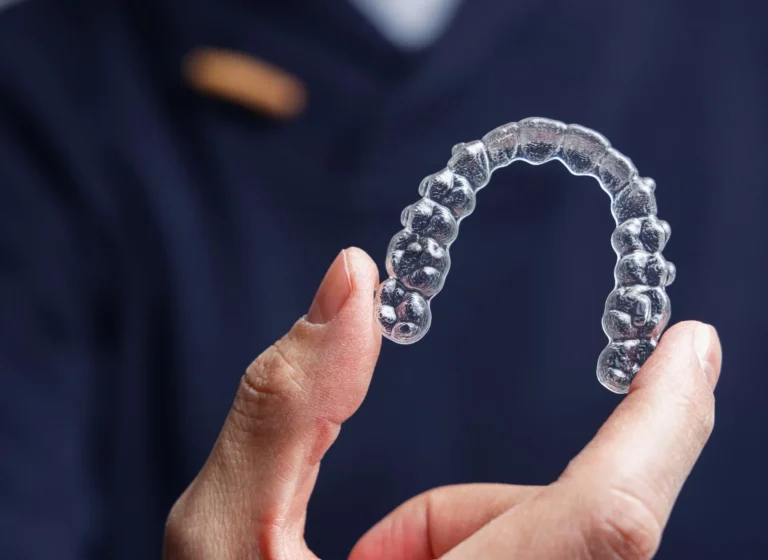
Can clear aligners correct a crossbite?
If your upper and lower teeth do not meet correctly, you may have been told that you have a crossbite and may be wondering can clear aligners correct a crossbite without requiring fixed braces. In selected cases, the answer is yes. Clear aligners can gradually move individual teeth and groups of teeth into more appropriate positions, and crossbite is among the orthodontic problems that may sometimes be treated with aligners. However, not every crossbite has the same cause or requires the same treatment.
A crossbite can affect the front teeth, the back teeth, one side of the mouth or several teeth at the same time. Some crossbites are mainly dental, meaning that the position of the teeth is the principal problem. Others are related to the width or position of the jaws and are therefore more skeletal in nature. This distinction is important because clear aligners move teeth but cannot always provide the type of jaw expansion or skeletal correction required in more complex cases.
Age also matters. In a growing child, orthodontic treatment may take advantage of jaw development, sometimes using an expander before or alongside other orthodontic appliances. In adults, where jaw growth is complete, treatment planning can be different.
At Kings Medical Center in Dubai, orthodontic services include clear aligners, fixed orthodontics, interceptive orthodontics and other approaches, supported by digital scanning and radiographic technologies.
The right question is therefore not simply whether aligners can treat crossbite, but what type of crossbite you have and which movement is required to correct it safely and predictably.
What is a crossbite?
A crossbite is a type of malocclusion, meaning that the upper and lower teeth do not meet in their expected relationship when the mouth closes. Normally, the upper teeth sit slightly outside the corresponding lower teeth. With a crossbite, one or more upper teeth may instead sit inside the lower teeth.
There are two main forms patients commonly encounter.
An anterior crossbite affects the front of the mouth. One or more upper front teeth sit behind the corresponding lower front teeth when the patient bites together. When the relationship involves most or all of the front teeth and the lower jaw or teeth project forwards, patients may also hear terms such as underbite, although the two descriptions are not always interchangeable.
A posterior crossbite affects the back teeth. In this situation, the upper premolars or molars may bite inside the lower teeth on one side or both sides of the mouth. A less common variation can occur when an upper back tooth bites completely outside its lower counterpart.
Crossbites can also be described according to their cause. A dental crossbite occurs primarily because individual teeth are positioned incorrectly. A skeletal crossbite involves a discrepancy in the width or relationship of the jaws. Some patients have a combination of both.
This distinction cannot reliably be made by looking at a selfie or checking the teeth in a mirror. The orthodontic assessment may include examination of the bite, digital scans, photographs and radiographs when clinically necessary.
Understanding the cause is essential because two people who both have a crossbite may need completely different treatments. Moving one incorrectly positioned incisor into the correct relationship is very different from treating a narrow upper jaw that affects several posterior teeth.
Can clear aligners correct a crossbite in every patient?
Clear aligners can correct certain crossbites, but they are not suitable for every case.
The American Association of Orthodontists identifies crossbite among the conditions that can sometimes be treated with clear aligners. At the same time, it emphasises that aligners are not appropriate for every orthodontic problem and that some cases are treated more predictably with fixed appliances or combinations of orthodontic techniques.
The key issue is the type of movement required.
Imagine that one upper front tooth has erupted slightly behind the corresponding lower tooth while the jaw relationship is otherwise appropriate. In a suitable case, an aligner may be able to apply controlled pressure and gradually move that tooth forward into a more favourable position.
Now consider a patient whose entire upper jaw is significantly narrower than the lower jaw. Several upper back teeth may therefore sit inside the lower teeth. Simply tipping those teeth outward may not address the underlying skeletal discrepancy. Depending on age and severity, the orthodontist may need to consider expansion or another treatment strategy.
This is why the severity of the crossbite is only one part of the assessment. The orthodontist also needs to determine:
- whether the problem is dental or skeletal;
- which teeth are involved;
- whether the upper jaw is narrow;
- whether the lower jaw shifts when the patient closes;
- the patient’s age and remaining growth;
- the amount and direction of tooth movement required;
- gum and bone health;
- whether additional orthodontic appliances may be necessary.
Clear aligners are therefore a treatment tool rather than a universal solution. Their suitability depends on whether the desired tooth movements can be achieved within an appropriate and stable orthodontic plan.
Can clear aligners correct an anterior crossbite?
Selected anterior crossbites can be suitable for treatment with clear aligners, particularly when the problem is mainly caused by the position of individual teeth rather than a major discrepancy between the jaws.
There is clinical research supporting their use in carefully selected cases. A randomised clinical trial involving children aged 8 to 12 with functional anterior crossbite compared clear aligners with removable inclined-plane appliances. Both approaches corrected the anterior crossbite during the study period, while the aligner group produced greater labial movement of the upper incisors and increases in certain arch measurements.
This does not mean that every child or adult with an anterior crossbite should automatically receive aligners. The participants in a clinical trial are selected according to specific criteria, and individual orthodontic problems can differ significantly.
An anterior crossbite may involve:
- a single upper incisor;
- several front teeth;
- crowding or lack of space;
- an abnormal inclination of the incisors;
- a functional shift of the lower jaw;
- a broader skeletal Class III relationship.
Clear aligners may be particularly useful when controlled tooth movement is sufficient to establish the correct relationship. In more complicated situations, treatment may require other appliances, elastics, expansion or a different orthodontic strategy.
Timing can also be important in children. An anterior crossbite that influences the way the lower jaw closes should be assessed rather than simply ignored while waiting for more permanent teeth to erupt.
For adults, the absence of jaw growth changes the treatment possibilities. A primarily dental anterior crossbite may still be corrected orthodontically, while a significant skeletal discrepancy may require a more complex approach.
The treatment decision should therefore begin with diagnosis rather than choosing the appliance first.
Can clear aligners correct a posterior crossbite?
A posterior crossbite can sometimes be improved with clear aligners, but these cases require particularly careful diagnosis because the problem may reflect tooth position, jaw width or both.
When a posterior crossbite is mainly dental and relatively limited, aligners may be able to move or tip selected teeth into a more favourable relationship. Modern aligner treatment can also incorporate additional orthodontic components when clinically appropriate. However, clear aligners are not capable of providing every type or degree of transverse correction.
The American Association of Orthodontists explains that posterior crossbites in growing patients may sometimes require a palatal expander to widen the upper jaw. After expansion, braces or clear aligners may then be used to reposition the teeth and refine the bite.
This sequence highlights an important difference between moving teeth and changing the width of the underlying jaw.
Suppose the upper jaw is adequately developed but two upper premolars lean inward. Tooth movement alone may be sufficient.
By contrast, if the entire upper arch is narrow and several upper back teeth bite inside the lower teeth, simply moving the crowns outward may not provide the same result as addressing the underlying transverse discrepancy.
Children and adolescents may have more options for influencing jaw development because growth is still occurring. In adults, the skeletal structures are mature, so significant transverse discrepancies may require different orthodontic or surgical considerations depending on severity.
Posterior crossbite should therefore not be self-diagnosed based only on how one tooth appears. A clinician needs to assess the complete upper and lower arches and how the jaw closes before deciding whether clear aligners alone are appropriate.
Why does it matter whether a crossbite is dental or skeletal?
The distinction between a dental crossbite and a skeletal crossbite is one of the most important factors in deciding whether clear aligners may be suitable.
A dental crossbite occurs mainly because one or more teeth are positioned or inclined incorrectly. The bones supporting the teeth may have an acceptable relationship, but the teeth themselves do not meet correctly.
Because clear aligners are designed to move teeth progressively, this type of problem can sometimes be particularly suitable for aligner treatment.
A skeletal crossbite is different. It may result from a narrow upper jaw, an abnormal relationship between the upper and lower jaws or asymmetric growth. In these cases, simply moving the teeth does not necessarily correct the underlying anatomical problem.
The AAO notes that crossbites can arise from misalignment of either the teeth or the jaws, and treatment depends on the extent and nature of the condition. In growing patients with a narrow upper jaw, palatal expansion may be used before further orthodontic tooth movement.
This distinction also explains why an orthodontist may recommend something different from what a patient initially expected.
A patient may arrive specifically requesting aligners because they prefer a removable appliance. After examining the bite, however, the orthodontist may determine that expansion, fixed appliances or a combined approach would produce a more appropriate result.
The appliance should follow the diagnosis, not the other way around.
At Kings Medical Center, the orthodontic team has access to different treatment approaches rather than relying on one method for every case. Clear aligners, fixed orthodontics and interceptive orthodontics are among the available services.
This allows treatment planning to focus on what actually needs to be corrected.
Can children with a crossbite use clear aligners?
Clear aligners can be considered for selected children, but treatment during childhood has additional objectives because the teeth and jaws are still developing.
Research has shown that clear aligners can successfully correct certain anterior crossbites during the mixed dentition stage. In a recent randomised clinical trial involving children aged 8 to 12, both clear aligners and a removable inclined-plane appliance successfully treated functional anterior crossbite over the study period.
However, a posterior crossbite associated with a narrow upper jaw may require a different approach.
The AAO explains that palatal expanders are commonly used in growing patients when the objective is to widen the upper jaw. Expansion can help correct transverse discrepancies before or alongside subsequent tooth alignment.
Early evaluation can be particularly useful when a crossbite causes the lower jaw to shift sideways during closure. The AAO notes that untreated crossbite during growth can be associated with uneven jaw development, abnormal enamel wear and functional problems.
This does not mean that every crossbite needs immediate treatment at the first sign of misalignment. The appropriate timing depends on the type of crossbite, the teeth involved and the stage of development.
For parents, it is best to avoid trying to correct a child’s bite using appliances bought online or following exercises promoted on social media. Orthodontic forces applied during growth need to be carefully controlled, and an appliance that is inappropriate for the child’s anatomy can move teeth in unwanted directions.
At Kings Medical Center, interceptive orthodontics is among the treatments available for younger patients. A clinical evaluation can determine whether monitoring, aligners, expansion or another approach is more appropriate.
Can adults correct a crossbite with clear aligners?
Adults can also receive orthodontic treatment for crossbite, and age alone does not automatically prevent tooth movement with clear aligners. What changes in adulthood is that jaw growth has essentially finished, which can affect the treatment possibilities when the crossbite has an important skeletal component.
If the problem is primarily dental, aligners may be able to reposition teeth and improve their relationship. Depending on the case, additional orthodontic features such as attachments or elastics may be incorporated into treatment to help deliver particular movements. The AAO notes that aligners can sometimes be combined with orthodontic elastics and that treatment selection depends on the complexity of the malocclusion.
When the discrepancy is skeletal, treatment becomes more individualised.
A mild transverse discrepancy may sometimes be managed orthodontically through dentoalveolar tooth movement. More significant skeletal problems may require another form of expansion or, in selected severe adult cases, surgical orthodontic assessment.
Oral health is also particularly important when treating adults. Before moving teeth, the condition of the gums and supporting bone should be evaluated. The AAO stresses that orthodontic treatment in the presence of poor periodontal health can increase risks such as gum recession or loss of supporting tissues.
Adults who have crowns, bridges, implants or missing teeth may also require additional planning because these restorations can influence how orthodontic forces are managed.
For this reason, being told that a friend corrected their crossbite with aligners does not mean the same treatment will necessarily work for you.
The orthodontist needs to determine whether your crossbite can be corrected through dental movement alone or whether the underlying jaw relationship requires another strategy.
How do clear aligners move teeth out of a crossbite?
Clear aligners work by applying controlled forces to the teeth over a planned sequence of movements.
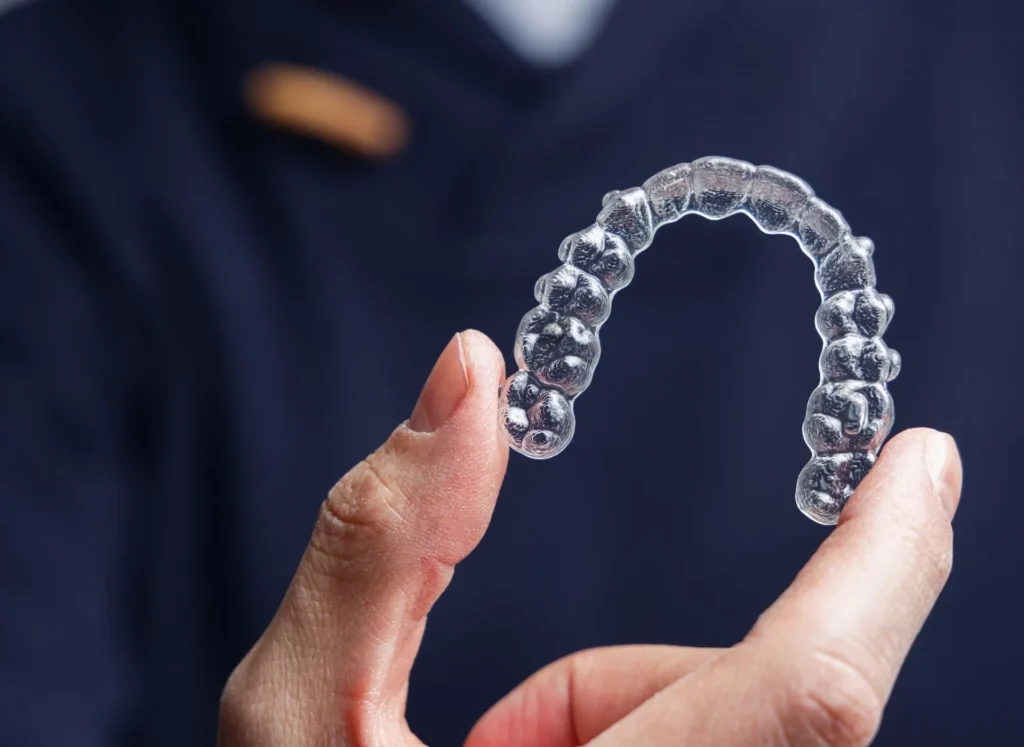
Rather than using brackets and wires attached to the teeth, a series of removable trays is made to fit the teeth at different stages of treatment. Each aligner is designed to move selected teeth incrementally towards their planned positions.
When correcting a crossbite, the exact movement depends on the problem.
An upper front tooth positioned behind the lower teeth may need to move forward. A posterior tooth leaning too far towards the tongue may need controlled movement towards the cheek. Other teeth may need to move simultaneously to create sufficient space or establish a stable bite.
Small tooth-coloured attachments may sometimes be placed on the teeth to help the aligners grip them and deliver specific forces. Orthodontic elastics can also be incorporated in selected cases.
However, digital planning should not be confused with a guarantee that every planned movement will occur exactly as simulated.
Orthodontic treatment is biological. Teeth move through bone in response to controlled forces, and individual responses vary. Progress therefore needs to be monitored clinically, and the treatment plan may occasionally require adjustment.
At Kings Medical Center, intraoral scanning, panoramic radiography, lateral cephalometric imaging and 3D cone-beam imaging are among the technologies available when clinically appropriate.
These tools can support diagnosis and planning, but they do not replace the orthodontist’s clinical judgement.
Successful crossbite correction is not simply about making individual teeth look straighter. The final objective is to establish an appropriate relationship between the upper and lower teeth when the patient closes, bites and chews.
How long does it take to correct a crossbite with clear aligners?
There is no standard treatment duration for crossbite correction with clear aligners.
Treatment time depends on the number of teeth involved, severity of the crossbite, whether the problem is dental or skeletal, additional crowding or spacing, the movements required and how consistently the aligners are worn.
The AAO explains that the number of aligners and overall treatment duration varies according to the individual’s orthodontic problem and the movements required to correct it.
A relatively localised anterior crossbite may require substantially less movement than a case involving both arches, multiple posterior teeth, crowding and a broader bite discrepancy.
Treatment may also occur in stages.
For example, a growing patient with a narrow upper jaw might first undergo expansion and then use orthodontic appliances or aligners to refine tooth positions. In that situation, quoting only the duration of the aligner phase would not represent the entire treatment process.
Patient cooperation matters as well because clear aligners are removable. They need to be worn according to the orthodontist’s instructions for the planned movements to occur. If they are regularly left out for extended periods, teeth may not track according to the plan and treatment can become less predictable.
This is another reason patients should be cautious of websites or online providers promising that a crossbite can be corrected in a fixed number of weeks without an examination.
The aim should not be to finish treatment as quickly as possible, but to move the teeth at an appropriate rate while establishing a functional and stable bite.
An orthodontic assessment is therefore necessary before estimating treatment duration for an individual patient.
Why should a crossbite be treated rather than ignored?
A crossbite is not always only an aesthetic issue.
Depending on its type and severity, an untreated crossbite may influence tooth wear, chewing function and the way the jaw closes. In growing patients, certain crossbites can also contribute to asymmetric jaw development if the lower jaw repeatedly shifts to one side to find a comfortable bite.
Imagine that every time you close your mouth, your lower jaw has to move slightly sideways because the upper teeth block a natural closure. Repeating that movement thousands of times during eating, speaking and swallowing can create a functional pattern that should be evaluated, particularly while a child is still growing.
Crossbite can also create unusual points of tooth contact. When one tooth repeatedly bites against another in an unfavourable way, enamel wear may develop over time.
This does not mean that every small crossbite will inevitably cause serious problems. The clinical significance varies considerably between patients.
The purpose of an orthodontic assessment is therefore to establish:
- whether the crossbite is affecting function;
- whether there is a mandibular shift;
- whether teeth are wearing abnormally;
- whether gum health is affected;
- whether growth may worsen the discrepancy;
- whether immediate treatment is advisable or monitoring is sufficient.
Waiting without professional evaluation simply because the teeth are not painful is not always the best approach. Orthodontic problems often develop without producing pain.
At the same time, treatment should not be undertaken purely because a patient has seen a supposed crossbite online. A proper diagnosis remains the first step.
When are braces or expanders better than clear aligners for a crossbite?
Clear aligners offer advantages for many patients, but there are circumstances in which fixed braces, expanders or combined orthodontic treatment may be more appropriate.
According to the AAO, clear aligners can treat several orthodontic problems, including crossbite, but some cases are more predictably managed with braces. Braces can address a broad range of malocclusions and do not depend on the patient remembering to wear a removable appliance.
Expansion may become important when a posterior crossbite is related to a narrow upper jaw.
In growing children, a palatal expander can gradually widen the upper jaw and address the underlying transverse discrepancy. Clear aligners or braces may then be used afterwards to refine the positions of individual teeth.
A clinician may favour another approach when:
- the skeletal discrepancy is significant;
- substantial jaw expansion is required;
- tooth movements are complex;
- patient cooperation with removable aligners may be unreliable;
- several bite problems need correction simultaneously;
- growth modification is required;
- treatment would be more predictable with fixed appliances.
There is no reason to consider needing braces or an expander a failure of aligner treatment. Different orthodontic tools exist because different problems require different types of force.
At Kings Medical Center, the availability of clear aligners, fixed orthodontics and interceptive orthodontics allows the treatment approach to be selected according to the case rather than according to one preferred appliance.
The best appliance is ultimately the one capable of producing the required correction safely and predictably.
Can you correct a crossbite with aligners bought online?
Attempting to treat a crossbite using mail-order aligners, unsupervised appliances or DIY orthodontic techniques is not recommended.
A crossbite cannot be appropriately treated without first determining its cause. What looks like one misaligned tooth may actually be part of a larger problem involving jaw width, tooth inclination, crowding or a functional shift.
Moving teeth without understanding these relationships can alter the bite in ways that were not intended.
An in-person orthodontic assessment also allows gum health, tooth health and supporting bone to be evaluated before treatment begins. The AAO emphasises that proper diagnosis is the starting point for aligner treatment and notes that gum health needs clinical assessment before orthodontic tooth movement.
Patients should therefore avoid:
- modifying or heating aligners themselves;
- using elastic bands around teeth to move them;
- buying expansion devices online;
- filing teeth at home to create space;
- copying another person’s aligner schedule;
- continuing treatment when the bite feels progressively worse without seeking professional advice.
Orthodontic tooth movement is a biological process. Forces applied in the wrong direction or without appropriate monitoring can potentially affect teeth, gums and supporting structures.
Professional supervision also allows the treatment to change when necessary. If teeth are not moving as planned, the orthodontist can reassess the bite and decide whether additional aligners, different mechanics or another appliance is required.
Convenience should never replace diagnosis.
If you believe you have a crossbite, the safest first step is an orthodontic examination to identify whether the problem involves individual teeth, the jaws or both.
How does an orthodontist decide if clear aligners are right for your crossbite?
Determining whether clear aligners are suitable requires much more than looking at the front of the smile.
The orthodontist first needs to identify which teeth are in crossbite and why.
The examination typically focuses on how the upper and lower teeth meet, whether the jaw shifts when closing, the width of both arches, tooth positions, available space and the patient’s facial and jaw relationships. Records such as photographs, digital scans and appropriate radiographs may be collected when clinically necessary.
The orthodontist can then determine whether the problem is primarily dental, skeletal or combined.
If the crossbite can be corrected through tooth movement that aligners can deliver predictably, clear aligners may be a suitable option. If jaw expansion, more complex mechanics or a different type of control is required, another treatment may be recommended.
Other considerations include:
- age and remaining growth;
- gum and bone health;
- previous orthodontic treatment;
- missing or restored teeth;
- other bite problems;
- patient cooperation;
- treatment objectives.
The AAO advises that an accurate diagnosis should come before the choice of appliance and that patients who prefer clear aligners may sometimes be advised to use braces if aligners are not the optimal option for their particular orthodontic problem.
At Kings Medical Center in Dubai, orthodontic care is provided within a multidisciplinary dental team, with clear aligners, fixed appliances and interceptive orthodontic options available alongside digital diagnostic technologies.
This makes it possible to choose treatment according to the bite itself rather than trying to make every crossbite fit the same solution.
Conclusion: can clear aligners correct a crossbite?
So, can clear aligners correct a crossbite? Yes, clear aligners can be an effective orthodontic option for certain crossbites, particularly when the problem can be corrected primarily through controlled movement of the teeth. The American Association of Orthodontists includes crossbite among the conditions that may be treated with clear aligners, while clinical research has also demonstrated successful clear-aligner treatment of selected anterior crossbites.
However, not every crossbite should be treated with aligners alone.
The most important distinction is whether the crossbite is dental or skeletal. If individual teeth are incorrectly positioned, aligners may be capable of moving them into a better relationship. If the upper jaw is too narrow or there is a significant skeletal discrepancy, expansion, fixed orthodontics or another treatment approach may be required.
Age, growth, gum health, the number of teeth involved and the complexity of the bite also influence treatment planning.
For this reason, avoid choosing orthodontic treatment based only on appearance, online simulations or DIY aligner systems. Correcting a crossbite requires an understanding of how the entire upper and lower dentition function together.
At Kings Medical Center, the orthodontic team can assess the position of your teeth and jaws, review the type and severity of the crossbite and determine whether clear aligners, fixed orthodontics, interceptive treatment or a combined approach is most appropriate.
If you think you have a crossbite or would like to know whether clear aligners may be suitable for you, contact Kings Medical Center to arrange an orthodontic assessment and receive a treatment plan based on your individual bite and oral health.
Kings Medical Center in Dubai Deira
Address: Al Rigga Business Center
Visit our Dental Area or Skin Area.